
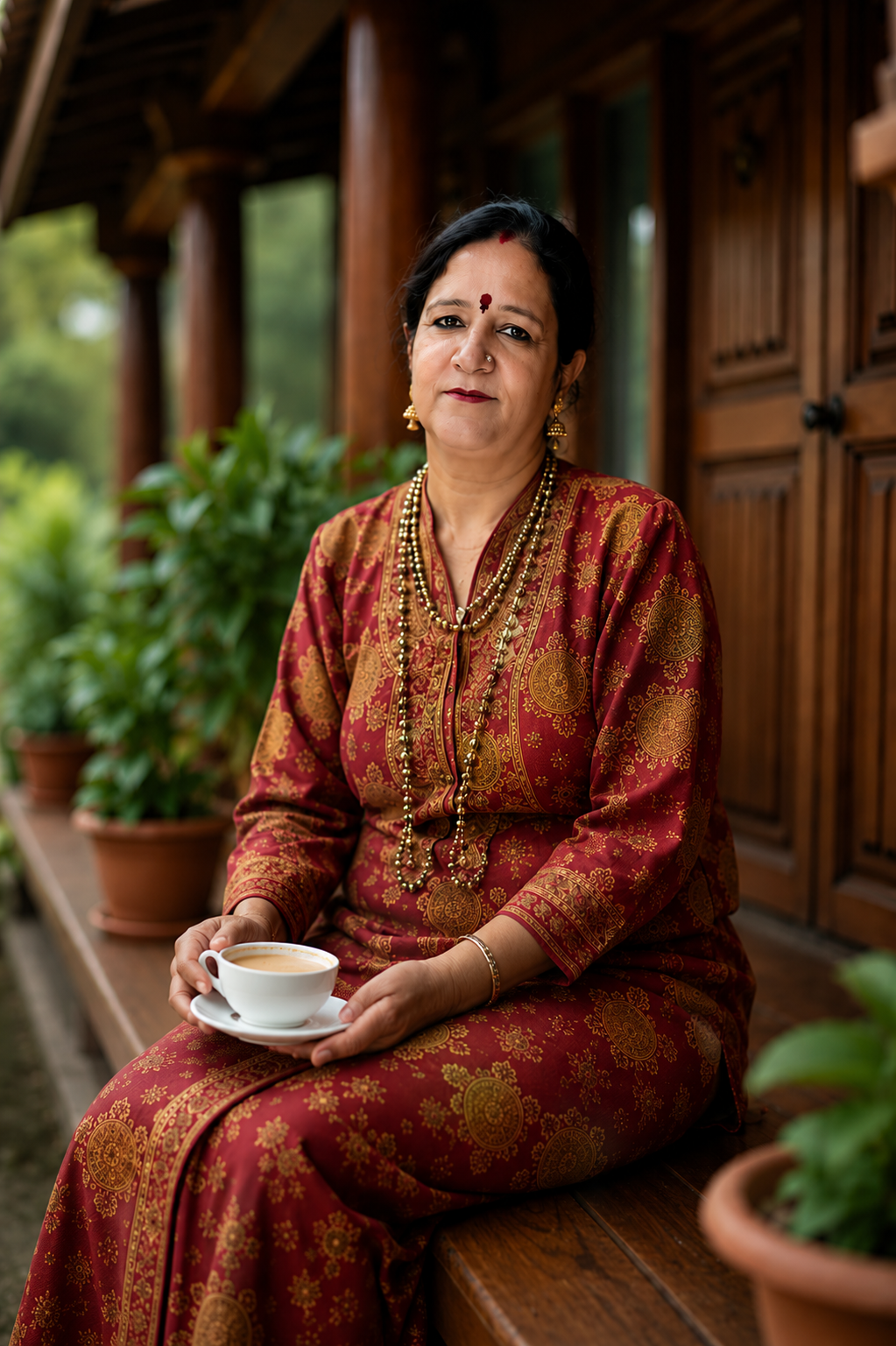
Archana Tandon spent thirty years teaching art. She ran a school called Aadhunik Kala Kendra, where she taught children to paint silk, embroider, shape clay, and write the kind of careful letter that takes time. She closed the school in the year 2000 to raise her two children. For the next twenty years she was a mother first.
The children grew up. The house went quiet. She had always meant to make something of her own again, but the right moment kept passing.
In the spring of 2025, she walked into a shop and picked up a bottle of soap. She read the label, put it back, and picked up another. She read three more. She bought none of them.
That weekend, she pressed the first bar at her kitchen counter. Coffee, masoor daal, almond oil, rose water. The same things she already cooked with. She poured the mixture into a stainless steel tin and waited four weeks. The first bar worked. So did the second.
"मैंने पहली साबुन अपनी रसोई में बनाई। बस वही चीज़ें जो वहाँ पहले से थीं।"
I made the first soap in my own kitchen. Only the things that were already there.
By the end of that month, eleven people were using it. By the end of the year, a hundred.
She began writing the recipes down properly. She made the ubtan her own mother had made for her the week before her wedding. She made a honey soap with real honey from a friend in Kashmir who keeps bees. She made a neem bar from the tree behind her house, the same tree that was there when she was a girl.
The hair oil came in the autumn. Her son, who is thirty, had begun to notice his hairline. She assembled an oil from onion, methi, kalonji, amla, bhringraj, almond, coconut. He used it for six weeks. The hairline came back. He told his friends. They told theirs.
Today there are nineteen things on her workbench. Eighteen soaps and one hair oil, gathered into six Ayurvedic-inspired rituals. Every batch is pressed by hand. Every bar is cured for four weeks before it leaves the workshop. Every bottle is sealed the morning it is filled.
Archana Veda makes a hundred bars a week. The number is deliberate. The capacity is exactly what one pair of hands can do without losing the slowness that makes the work worth doing.
"और 'वेद' नाम क्यों? क्योंकि यह वही पुराना ज्ञान है जो माँ अपनी बेटी को देती है।"
And the word Veda in the name? Because this is the older knowledge. The kind a mother passes to her daughter.
Every order is wrapped in glassine paper, packed in a kraft box, stamped in green ink, and tucked with a small handwritten card. It takes Archana about two hours of her morning to make each bar. It costs more than the soap in the shop and less than the soap in the spa. It lasts about a month if you let it dry between uses.
If a bar works, write back. If it does not, write back anyway. The workshop reads every message.
— Archana Tandon, sole maker · Lucknow, India